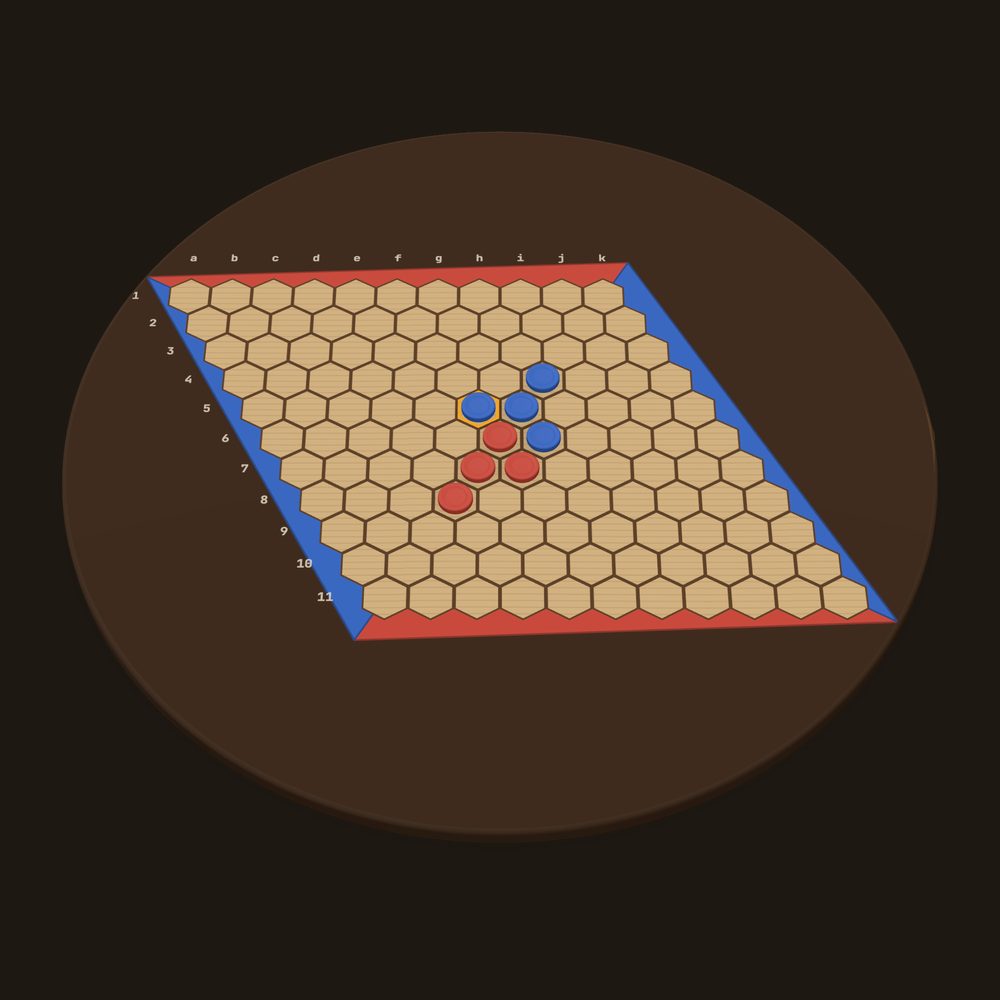
2Connect your two sides of the board with an unbroken chain of your stones.
3Every stone also blocks your opponent, so attack and defense are the same move.
4A game of Hex can't end in a draw: someone always connects.
Questions
Connect your two opposite sides of the board with an unbroken chain of your pieces. Win by creating a continuous chain of your pieces connecting your two opposite sides. It's mathematically proven that the game cannot end in a draw - one player must win.
The game is played on an 11x11 diamond-shaped board of hexagons (sizes vary from 7x7 to 19x19). Each player is assigned two opposite edges of the board. Black connects top-to-bottom, Red (or White) connects left-to-right.
The center is powerful - it can potentially contribute to paths in any direction. Build bridge connections (two pieces separated by two cells) - they create virtually connected chains. Look for forcing moves that threaten two connections simultaneously.
Hex was invented independently by mathematicians Piet Hein (1942) and John Nash (1948). Nash proved that the first player has a winning strategy, though finding it is computationally hard.
 boardgames.zone