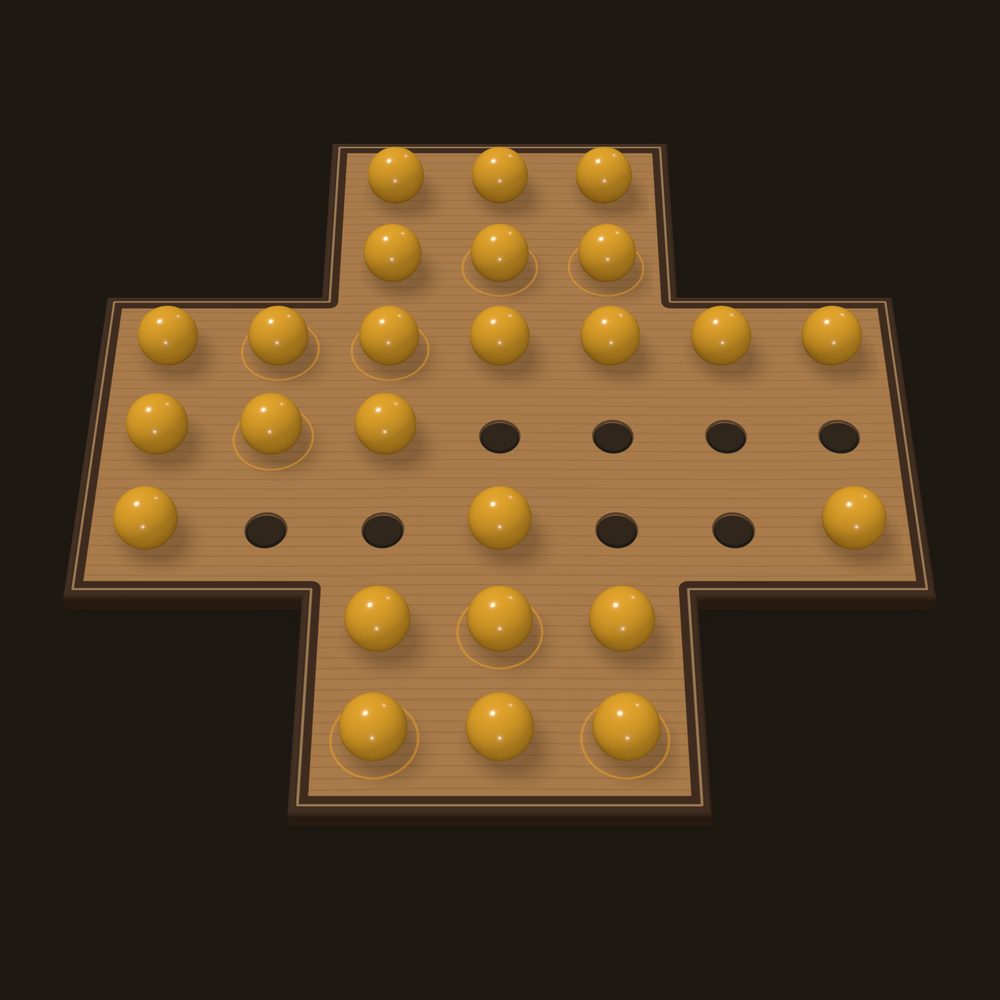
1Jump one peg over an adjacent peg into an empty hole.
2Jumps go across or down, never diagonally.
3The peg you jump over is removed.
4Finish with a single peg, ideally in the center hole.
Questions
Remove all but one peg from the board by jumping. The ultimate goal is to leave the final peg in the center. Solve by reducing to a single peg. The 'perfect' solution ends with the peg in the center. Any single-peg finish is a success; ending with multiple pegs means you're stuck.
The English board is cross-shaped with 33 holes. Start with 32 pegs filling all holes except the center. The European board is circular with 37 holes. Various other board shapes exist.
Work from the outside in - don't leave isolated pegs in corners early. Symmetry can help - try to maintain balanced positions. Learn patterns that clear sections efficiently.
English Board: 33-hole cross-shaped board (the standard). European Board: 37-hole circular/cross hybrid. Triangular Peg Solitaire: Triangle-shaped board, popular in restaurants. Different starting holes: Try starting with different positions empty.
Peg Solitaire became popular in France in the late 17th century. Legend credits its invention to a French prisoner in the Bastille, though its true origins are unknown.
 boardgames.zone