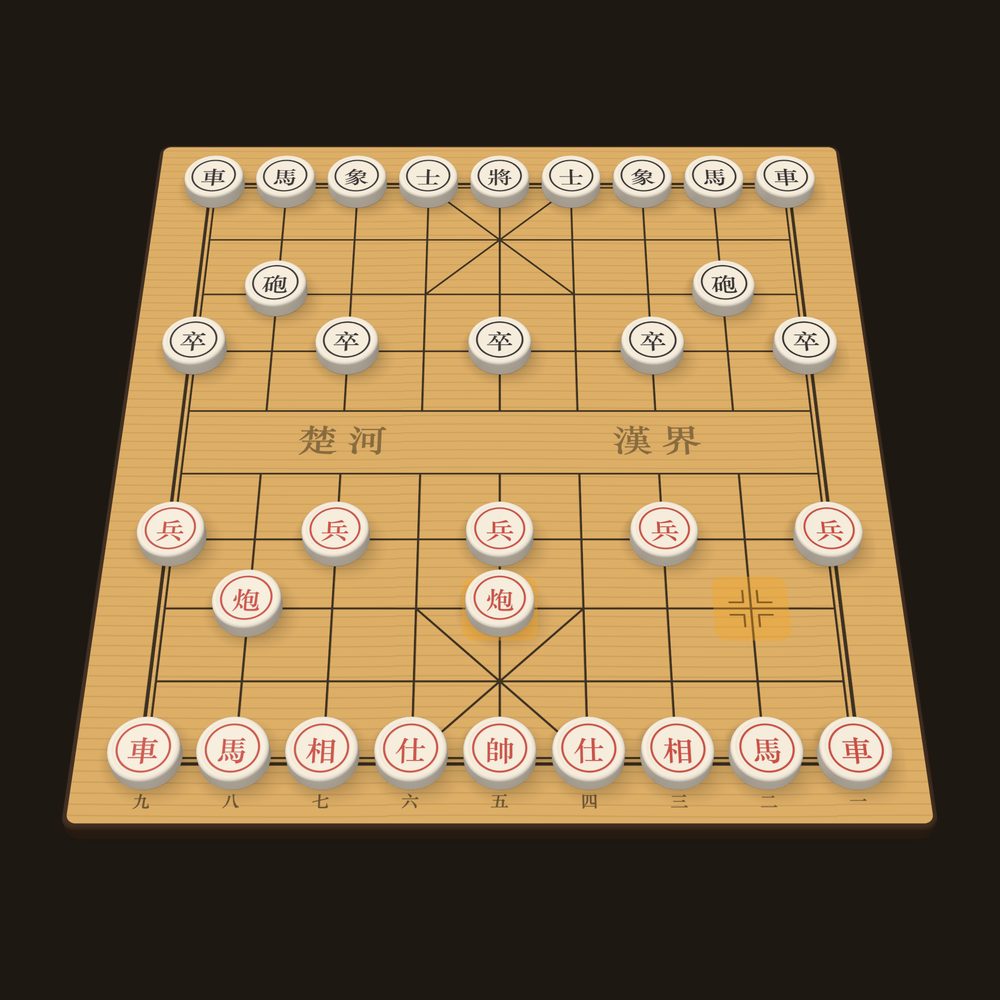
1Pieces stand on the intersections, not inside the squares.
2The river splits the board: elephants can't cross it, and soldiers can step sideways once over.
3The two generals may never face each other along an open file.
4A cannon captures by jumping exactly one piece; checkmate the general to win.
Questions
Checkmate or stalemate the opponent's General (King). Unlike international chess, stalemate is a loss for the stalemated player. Checkmate or stalemate the opponent's General: a player who has no legal move loses. Players can also agree to a draw. When the same position comes up for the third time, a player who gave check with every move since it first appeared loses (perpetual check), as does one whose every move was a check or a new attack on an unprotected piece (perpetual chase; attacks by the General or a Soldier, and on the General or a Soldier that has not crossed the river, don't count). Otherwise the repetition is a draw.
Played on a 9x10 board with intersections. The board has a 'river' across the middle and two 'palaces' (3x3 areas). Each player has: 1 General, 2 Advisors, 2 Elephants, 2 Horses, 2 Chariots, 2 Cannons, and 5 Soldiers. Red moves first.
Control the center files - especially the important center file where Generals reside. Develop your Horses and Cannons early for attacking potential. The Cannon is most powerful early when there are many potential 'platforms'; use them aggressively.
Xiangqi evolved from the same Indian ancestor as international chess around 1,000 years ago. It has been played in China for centuries and remains more popular there than Western chess.
 boardgames.zone