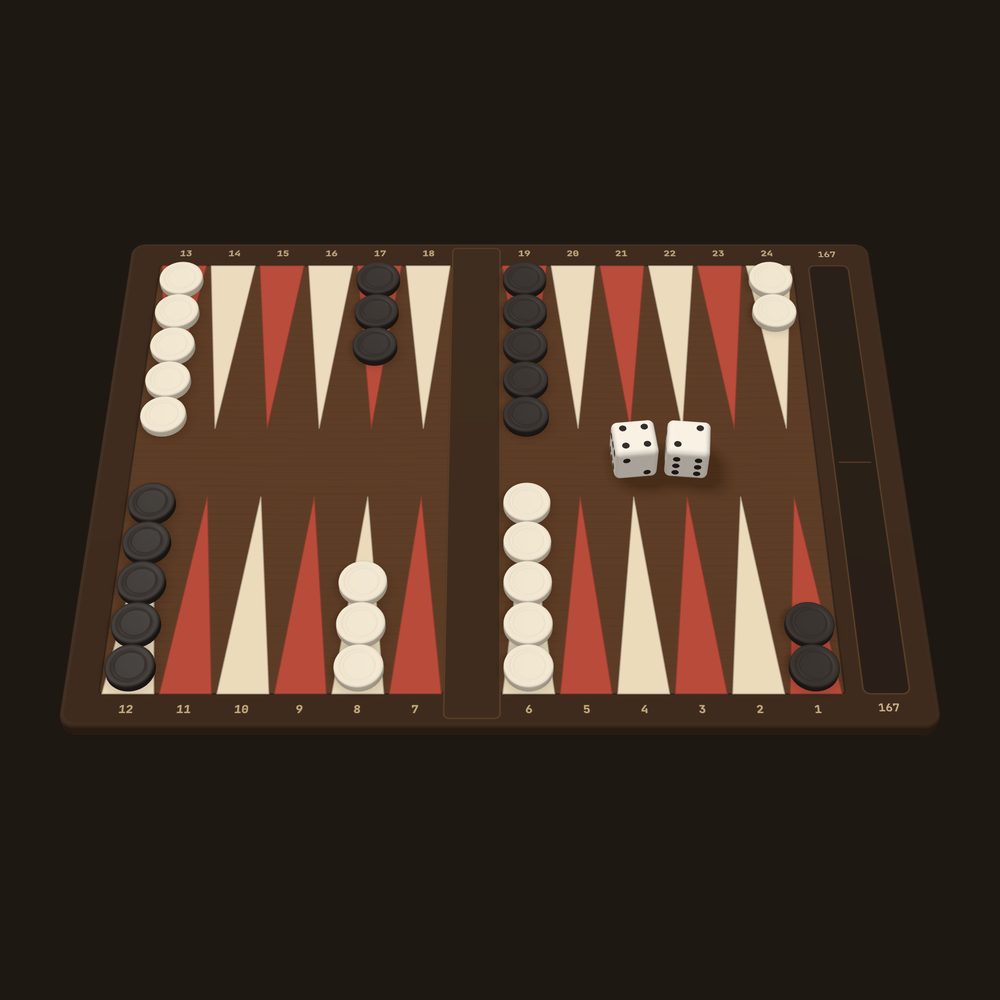
1Roll two dice and move your checkers that many points toward your home board.
2Hitting a lone enemy checker puts it on the bar, and it must re-enter before its owner moves anything else.
3Once all 15 of your checkers are in your home board, you can bear them off.
4The first player to bear off every checker wins.
Questions
Move all 15 of your checkers around the board and bear them off before your opponent does the same. The first player to bear off all 15 checkers wins. A 'gammon' (double win) occurs if the opponent hasn't borne off any checkers. A 'backgammon' (triple win) occurs if the opponent still has checkers on the bar or in your home board.
Each player starts with 15 checkers in a specific arrangement: 2 on the 24-point, 5 on the 13-point, 3 on the 8-point, and 5 on the 6-point. Players sit on opposite sides and move in opposite directions around the board.
Make points (two or more checkers) to block your opponent's movement. Building a 'prime' (six consecutive blocked points) traps enemy checkers behind it. Balance between aggressive blitzing (hitting) and building strong defensive positions.
Backgammon's ancestors date back 5,000 years to Mesopotamia. The modern game developed in the 1920s-1970s, with the doubling cube adding a gambling/strategic element.
 boardgames.zone