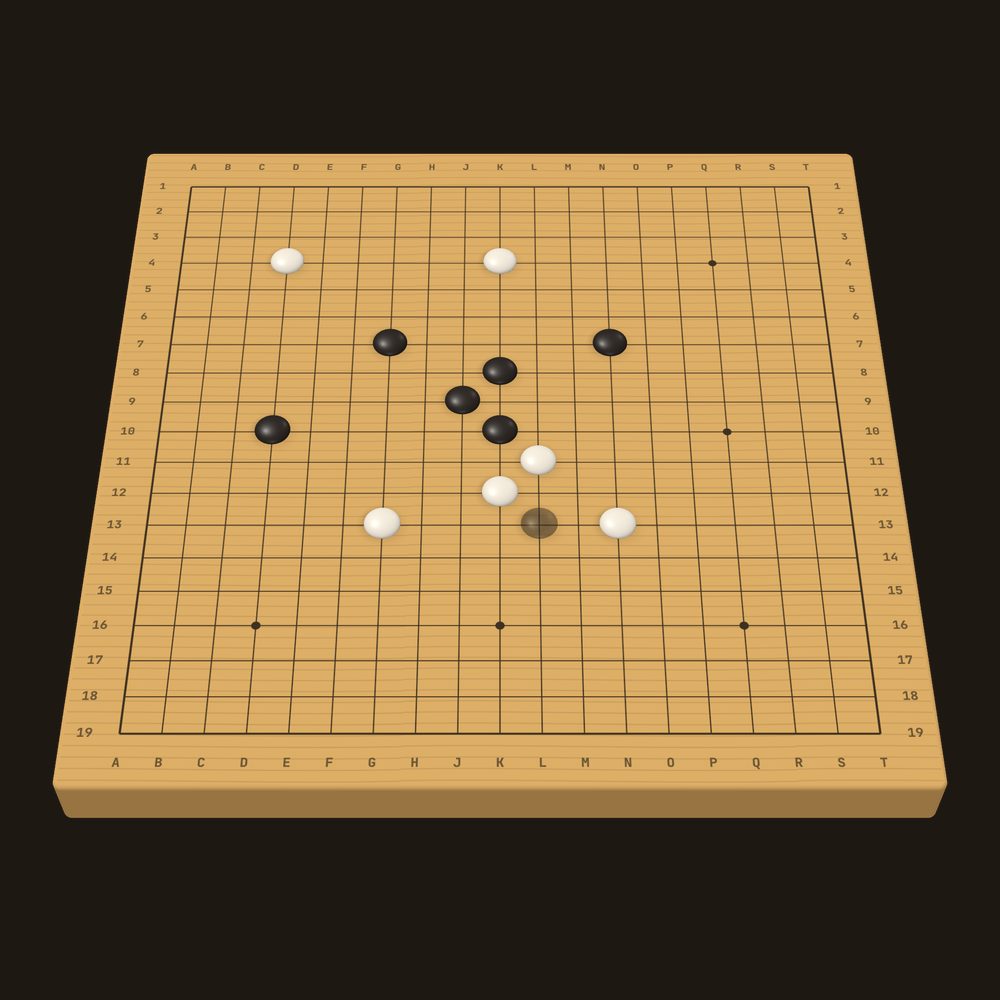
1Take turns placing one stone on an empty intersection; stones never move.
2A group with no empty point next to it is captured and leaves the board.
3The ko rule forbids retaking a single stone straight back, so a position can't repeat.
4When both players pass, whoever surrounds more territory wins.
Questions
Control more territory than your opponent. Territory consists of empty intersections completely surrounded by your stones, plus captured enemy stones. After both players pass, count territory. Add your surrounded empty points plus your prisoners. Subtract dead stones in your territory. White typically receives 6.5 points of komi (compensation for black's first-move advantage). Highest score wins.
The game is played on a grid (19x19 standard, but 9x9 or 13x13 for beginners). The board starts empty. Black places first. Players have an unlimited supply of stones in their color.
Start in the corners, then the sides, then the center - corners are easiest to secure. Keep your groups connected when possible; connected stones are harder to capture. Don't try to save every stone - sacrifice weak groups to build strong positions elsewhere.
Go originated in China over 4,000 years ago, making it one of the oldest board games still played today. It spread to Korea and Japan, where it became an art form studied by scholars and nobility.
 boardgames.zone